Advertisement
Space.Fan — Go Beyond
ApJ · 2 DAYS AGO
UniverseSIMULATION

A New Way Stars Might Explode

By Space.Fan Editorial Desk

Scientists have found that powerful jets inside a dying star could explain why they explode so quickly.
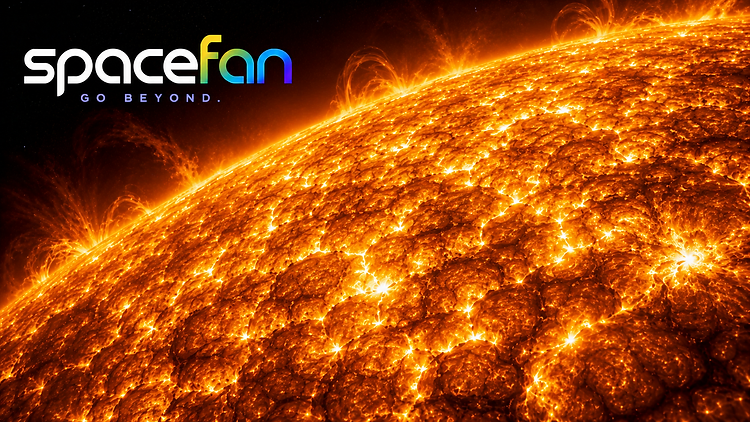
Close-up of the fiery Sun showing bright active regions and looping plasma above its surface.
Image · Space.Fan

The Drop

When a very large dies, it runs out of fuel and collapses inward. Scientists have long wondered exactly what causes these s to burst apart in a massive explosion called a . One popular idea is that tiny particles called neutrinos help push the 's material outward. But a new study suggests there might be another, faster process at work called the jittering jet explosion mechanism. To test this idea, researchers used computer models to simulate how s of different sizes behave as they near the end of their lives. These simulations tracked the 's layers to see how they fall toward the center of the , where a dense object called a is forming. The researchers discovered that as material falls, it can create powerful jets of energy that shoot out from the center. These jets appear to kick in very quickly, often before the neutrino process would have had a chance to work. By looking at s ranging from 12 to 40 times the mass of our sun, the team found that most of these s have the right conditions inside to trigger these jets. This suggests that the jittering jet mechanism is a very likely way for many s to explode.
Advertisement

Why It Matters

This research is important because it offers a new explanation for a major mystery in space science. If these jets are the primary engine for explosions, it changes how we model the death of s. It helps astronomers better predict what kind of debris and energy we should expect to see when a goes in our galaxy.
Advertisement

The Catch

The findings come from computer simulations, which are mathematical models of reality rather than direct observations of a dying . While these models are highly detailed, they make certain assumptions about how s behave. The researchers note that while this mechanism works for most of their simulated models, it might not be the answer for every single type of , meaning more study is needed.

Put That in Perspective

Scientists are working to understand how complex movements inside a star's core lead to the spectacular explosions we observe through telescopes. This study builds on years of work in stellar evolution to show that internal jets could be a key driver for these cosmic events.

Source November 20, 2026
Nikki Yat Ning Wang, Dmitry Shishkin, Noam Soker
Technion—Israel Institute of Technology·The Astrophysical Journal·10.3847/1538-4357/aeb542

Keep Exploring Space