Advertisement
Space.Fan — Go Beyond
ApJ · 2 DAYS AGO
UniversePEER REVIEWED

Astronomers Uncover the Secrets of a Rapidly Fading Supernova

By Space.Fan Editorial Desk

A rare, fast-changing supernova has given scientists a new look at how stars explode and cool down after their final moments.
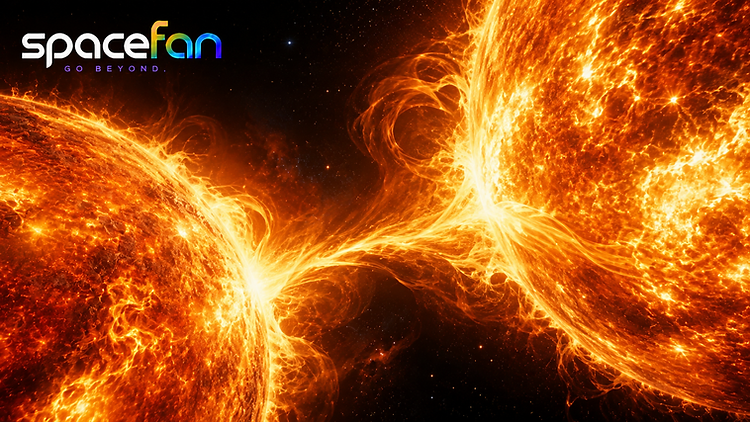
Two fiery stars interacting through huge glowing loops and streams of stellar plasma.

The Drop

When a massive dies, it ends in a violent explosion called a . Scientists recently studied a specific explosion named SN 2024aecx. This was unusual because it didn't just brighten once; it showed a double-peaked light pattern, meaning it got bright, dimmed a little, and then got bright again before fading away forever. By watching this light closely, researchers were able to map out what happened in the seconds and days after the blew up. They used complex computer models to figure out how the 's outer layers were structured. The team discovered that the was surrounded by a thin, spread-out cloud of gas before it exploded. As the shockwave from the explosion hit this cloud, it created the first flash of light that scientists recorded. After that, the heat came from radioactive materials left over in the center of the blast. By piecing together these two different sources of energy, the team could explain the full life cycle of this specific explosion.
Advertisement

Why It Matters

This discovery is important because it shows that s are more complex than we once thought. For a long time, scientists used simple rules to guess how these explosions should look. By looking at SN 2024aecx, researchers proved that those simple rules are not enough to explain every death. This helps us understand the different ways s can shed their outer layers before they go out. It gives us a better blueprint for what to look for when other s reach the end of their lives.
Advertisement

The Catch

While the team’s model explains most of the 's brightness, it still struggles to explain exactly why the faded so quickly at the end. The standard models for radioactive decay were not enough to match the data, suggesting there might be unknown forces or processes at play that scientists don't fully understand yet. This means the model is a great ting point but likely incomplete.

Put That in Perspective

In the past, astronomers often treated all supernovae of this type as similar events. Now, thanks to better telescopes and advanced computer modeling, they are starting to see that each explosion has a unique personality based on the star's specific size and shape. Researchers plan to use these new methods to study more distant explosions to see if they follow the same patterns.

Source October 2, 2026
ApJ

Keep Exploring Space