Advertisement
Space.Fan — Go Beyond
ApJS · 13 HR AGO
UniverseMODEL

Updating the Recipe for Kilonovae Explosions

By Space.Fan Editorial Desk

Scientists have improved the atomic data models used to study the bright, metallic light shows caused by colliding neutron stars.
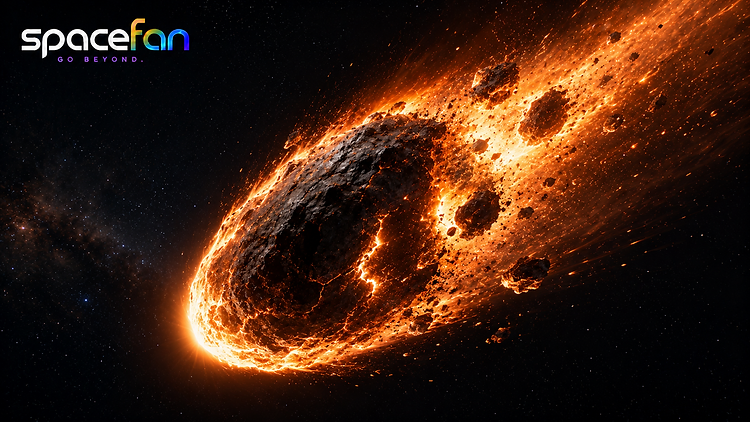
Large fractured asteroid engulfed in flames and glowing debris as it travels through space.
Image · Space.Fan

The Drop

When two incredibly dense s crash into each other, they trigger a violent event called a kilonova. This explosion creates a flash of light that contains clues about the heavy metals formed during the blast. To understand these events, researchers build computer models that predict how the leftover material glows as it cools down and spreads into space. For the first week after a crash, these models work well using simple assumptions. But as time goes on, the physics gets complicated, and researchers need much more detailed data to stay accurate. A team of scientists recently decided to update how we track one specific element: tellurium. This element is often found in the debris of collisions. By using a powerful tool called the Flexible Atomic Code, the team calculated how tellurium atoms interact with stray electrons released by the decay of radioactive material within the blast. They specifically looked at how these atoms lose electrons, a process known as ionization, which changes how the material reflects and emits light. The team tested their new calculations against previous measurements and found they were very accurate. Now, they have provided this new set of data to the public so other researchers can plug it into their own simulations. This update gives astronomers a better, more detailed map of how kilonovae change as they fade away, allowing us to better interpret the light signals we detect from deep space.
Advertisement

Why It Matters

Understanding kilonovae is the key to learning where the heaviest elements in the universe come from, such as gold, platinum, and tellurium. By improving the accuracy of our computer models, scientists can better identify what elements are present in the wreckage of these cosmic collisions. This helps us confirm our theories about how s create the building blocks of matter.
Advertisement

The Catch

These findings are based on computer simulations, which are only as good as the math behind them. While the data matches the limited lab tests available today, researchers still face challenges when applying these rules to the extreme, messy environment of a real exploding . The model does not capture every single atom present in a kilonova, only the specific states of tellurium they chose to study.

Put That in Perspective

Scientists have been studying kilonovae for years, but our tools are constantly evolving. Before this, many models used simplified estimates because detailed data on rare heavy elements was hard to come by. Researchers hope to use this new data to refine our understanding of light patterns, eventually allowing us to identify even more elements in the aftermath of these rare and powerful cosmic events.

Source October 3, 2026
ApJS

Keep Exploring Space