Advertisement
Space.Fan — Go Beyond
ApJ · 3 DAYS AGO
UniverseSIMULATION

How Bright Stars Keep Their Dusty Rings Alive

By Space.Fan Editorial Desk

Scientists found out why big, bright stars are surrounded by dust that should have been blown away long ago.
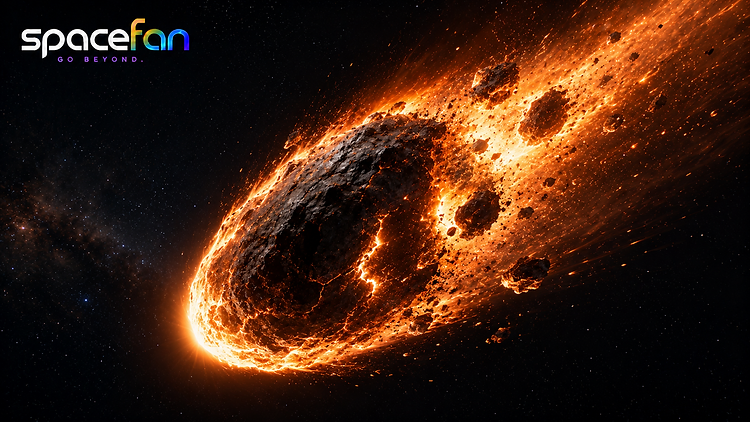
Large fractured asteroid engulfed in flames and glowing debris as it travels through space.
Image · Space.Fan

The Drop

Big, bright s known as A-type s are incredibly powerful. They give off so much light that their radiation acts like a strong wind. This light-wind should push away tiny pieces of dust, clearing the area around the . Yet, when scientists look at these s, they still see dust clouds nearby. This has been a big mystery because the dust should disappear very quickly. To figure out why this dust sticks around, researchers created advanced computer simulations. Instead of looking at simple patterns, they looked at how giant space rocks, called esimals, crash into each other. These collisions break the rocks into smaller pieces, creating a fresh supply of dust that replaces what gets blown away. By testing this idea on five different A-type s, the team found that these constant, smashing collisions happen just right to match what telescopes actually see. The simulations show that larger grains of dust stay in the area better than tiny bits, and their light signatures match the glowing dust clouds observed by astronomers. This study shows that we do not need strange or unknown processes to explain these dusty rings. Simple physics—like rocks bumping into each other and breaking apart—is enough to keep the dust clouds full, even while the 's bright light tries to push them away.
Advertisement

Why It Matters

Understanding how dust behaves around s is important because dust is the building block for s. By confirming that these dust rings come from colliding rocks, scientists can better understand the history of ary systems. It helps prove that these s likely host hidden belts of rocky material that we cannot see directly.
Advertisement

The Catch

The study relies on computer simulations to explain what we see, which means the results depend on how accurately the model represents real space. While the model fits the observations well, there could be other ways these systems produce dust. For example, some older s might have had a huge, recent crash between large objects that provided a temporary burst of dust, rather than a steady, long-lasting supply.

Put That in Perspective

Scientists previously struggled to explain the dust because traditional models assumed the light from A-type stars would simply clear the path. This new work highlights how important it is to account for the constant, messy history of collisions in a star system, rather than viewing the dust as a static feature.

Source November 20, 2026
T. A. Stuber, H. Kobayashi, S. Wolf, V. Faramaz-Gorka
The University of Arizona, Nagoya University, Kiel University·The Astrophysical Journal·10.3847/1538-4357/aeacc9

Keep Exploring Space