Advertisement
Space.Fan — Go Beyond
ApJL · 3 HR AGO
UniverseSIMULATION

How Newborn Neutron Stars Launch Massive Space Jets

By Space.Fan Editorial Desk

Super-powered magnetic stars may launch the fastest beams in the universe right after they are born.
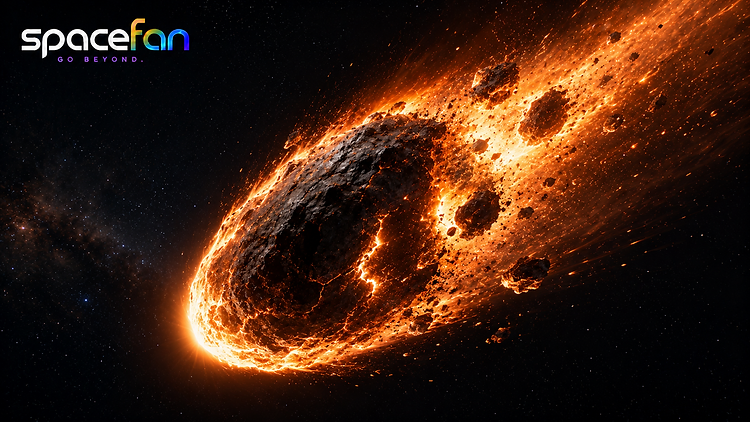
Large fractured asteroid engulfed in flames and glowing debris as it travels through space.
Image · Space.Fan

The Drop

When giant s die or crash together, they create an incredibly dense object called a . Some of these newborn s spin extremely fast and have very strong magnetic fields. Scientists call these millisecond protos. For a long time, experts have guessed these objects are the engines that power the brightest, shortest flashes of light in space, known as gamma-ray bursts. However, there was a big question. Right after these s are born, they blast out a lot of hot particles and energy that could act like a heavy shield. Some researchers thought this shield might be too thick, making it impossible for the to shoot out a fast jet of light. It was like wondering if a cannon could fire through a thick wall of fog. To find the answer, researchers used powerful computer programs to simulate exactly what happens in three dimensions. These computer models followed the laws of physics to track how energy and matter move around the during its first few seconds of life. The simulations showed that as the spins, it pushes heavy material toward its middle, or equator. This forms a thick ring of matter that acts like a wall. This ring forces the energy coming from the top and bottom of the to squeeze into a narrow, ultra-fast beam. This beam is strong enough to pierce through and travel across the universe as a gamma-ray burst.
Advertisement

Why It Matters

This discovery helps explain why the universe shows us such intense and sudden flashes of light. It confirms that these newborn s can indeed be the source of these bright events, even when they seem to be surrounded by messy debris. By showing how the 's own spinning forces create a narrow beam, the study helps scientists link different types of space explosions together. It fills a gap in our understanding of how high-energy events in deep space actually get ted.
Advertisement

The Catch

This study is based on computer models, not direct observations. While these models are designed to follow the laws of physics, they are still a simplified version of reality. Future research is needed to see if actual telescopes can find evidence that matches these specific patterns of light and motion in the real universe.

Put That in Perspective

Scientists have been trying to solve the mystery of gamma-ray bursts for years. Earlier theories used simpler, one-dimensional math that missed how spinning stars push matter around. By adding more dimensions to the computer model, researchers have moved closer to a real-world explanation for how these powerful cosmic engines work.

Source September 29, 2026
ApJL

Keep Exploring Space