Advertisement
Space.Fan — Go Beyond
ApJL · 1 DAY AGO
Sun & Space WeatherSIMULATION

How Super-Fast Jets Move Energy Through Space

By Space.Fan Editorial Desk

Scientists used computer models to see how magnetic energy bursts create high-speed jets near shock waves in space.
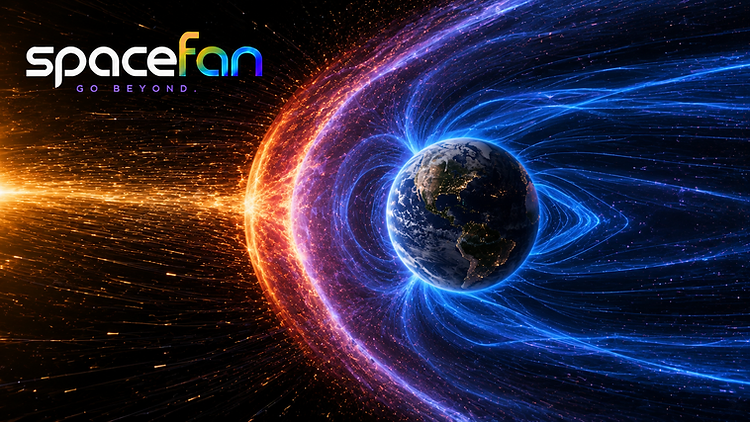
Earth surrounded by glowing magnetic field lines as solar particles strike the magnetosphere.
Image · Space.Fan

The Drop

In the vast emptiness of space, giant shock waves often form when solar wind crashes into the magnetic fields around s. Researchers recently used high-powered computer simulations to watch what happens behind these invisible walls. They found that fast-moving bursts of gas, called high-speed jets, form when waves from space press against the shock front. As these jets push forward, they twist the magnetic field lines like a rubber band being pulled too tight. This creates a special setup where the magnetic lines snap and reconnect, releasing a burst of energy. The team used a method called particle-in-cell simulation. This is a digital way of tracking how millions of tiny charged particles move and interact in magnetic fields. By running these models, they saw for the first time how these jets squeeze magnetic fields into thin sheets, which triggers the release of trapped energy. Their work also showed that the size and strength of these jets change depending on how heavy the particles involved are. Larger particles help create wider, longer-lasting jets compared to smaller ones.
Advertisement

Why It Matters

This discovery helps us understand how space weather can energize tiny particles called electrons. These electrons can travel at nearly the speed of light, which makes them dangerous for satellites and astronauts. By learning how these jets form and move energy, scientists can better predict how space storms might affect our technology in orbit.
Advertisement

The Catch

Because this research is based on a computer model, it is a simplified version of reality. Space is incredibly complex, and a two-dimensional simulation cannot capture every single detail of what happens in the three-dimensional, chaotic environment around a . It serves as a strong guide for what might be happening, but real-world measurements from space probes are needed to confirm these findings.

Put That in Perspective

Scientists have known about magnetic reconnection for a long time, but connecting it specifically to high-speed jets behind shock waves is a new step. Researchers plan to use these findings to better understand data collected by future space missions that fly directly through these shock regions.

Source November 21, 2026
Wanxin Ouyang, Zhongwei Yang, Quanming Lu, Gary P. Zank, Heli Hietala, Shuichi Matsukiyo, Can Huang, Binbin Tang, Wence Jiang, Tianran Sun, Xiaocheng Guo, Hui Li
National Space Science Center, CAS, University of Chinese Academy of Sciences, University of Science and Technology of China, University of Alabama in Huntsville, Queen Mary University of London, Kyushu University·The Astrophysical Journal Letters·10.3847/2041-8213/aeba7e

Keep Exploring Space