Advertisement
Space.Fan — Go Beyond
ApJ · 4 HR AGO
UniverseSIMULATION

Magnetic Energy Boosts Black Hole Glow

By Space.Fan Editorial Desk

Supercomputers reveal that magnetic fields around spinning black holes can make them shine much brighter than we previously thought.

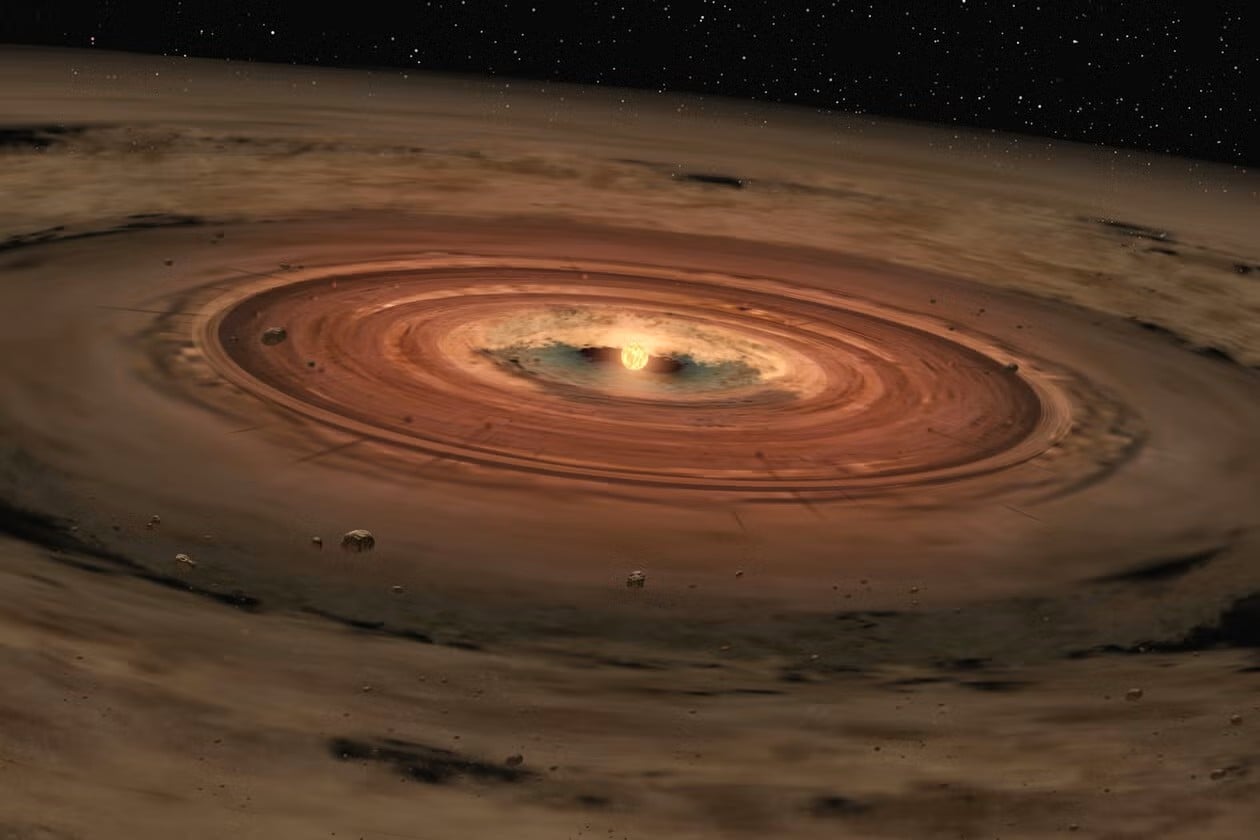
A black hole with a glowing accretion disk in deep space.
Image · Space.Fan

The Drop

Scientists have used powerful supercomputer simulations to look closely at how gas falls into s. When a spins very fast and has a strong magnetic field around it, the rules of how it glows change. Researchers modeled two different types of gas disks swirling into s to see what happens when the magnetic energy gets trapped near the center. They discovered that in some cases, the magnetic field works like a battery. It extracts energy and turns it into heat right near the edge of the . This process makes the area around the glow much brighter than it would if the magnetic fields were weaker or if the was not spinning. By comparing different models, the team found that the amount of light coming from these s can be several times higher than expected. This happens because the magnetic energy gets released as radiation instead of being pulled straight into the center of the . These simulations give us a clearer picture of how massive s stay so bright in the middle of distant galaxies.
Advertisement

Why It Matters

This research is important because it changes how we calculate the size and power of s. When astronomers look at bright s through their telescopes, they use the amount of light to guess how much gas the is eating. If we do not account for these magnetic boosts, we might guess the wrong size or speed of the . Understanding this process helps scientists read light data more accurately. It shows that the magnetic environment is just as important as the mass or spin of the when we study how they behave.
Advertisement

The Catch

This study is based on computer simulations, which are mathematical models of reality rather than direct photos of space. While these models are highly detailed, they simplify some of the complex physics that happen in deep space. We need more observations from real telescopes to confirm if these magnetic effects happen exactly this way in every galaxy.

Put That in Perspective

Scientists have known for a long time that black holes spin, but the impact of magnetic 'flux' has been harder to pin down. This new work highlights how magnetic energy shapes the extreme environment near a black hole's event horizon, and researchers will likely use these findings to build better models of black holes in the future.

Source September 28, 2026
Hiroyuki R. Takahashi, Ken Ohsuga, Ryohei Kobayashi, Akihiro Inoue, Yuta Asahina, Akira Nukada, Taisuke Boku
Komazawa University, University of Tsukuba, Institute of Science Tokyo, The University of Tokyo, RIST·The Astrophysical Journal·10.3847/1538-4357/aea28a

Keep Exploring Space