Advertisement
Space.Fan — Go Beyond
ApJ · 6 DAYS AGO
Sun & Space WeatherMODEL

Mapping the Sun's Invisible Magnetic Boundaries

By Space.Fan Editorial Desk

Scientists found a simpler way to track the Sun’s giant magnetic "fence" as it sweeps through our solar system.
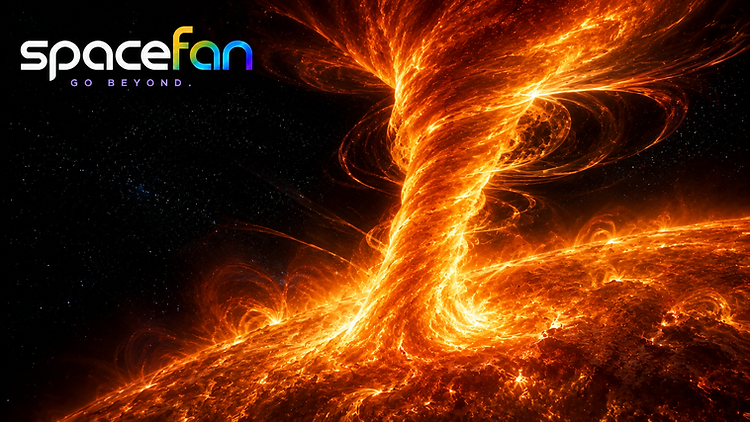
Huge twisting prominence of glowing plasma erupting above the surface of the Sun.
Image · Space.Fan

The Drop

The Sun creates a giant, wavy sheet of magnetic energy that stretches far out into space. This is called the heliospheric current sheet. It acts like a giant, invisible fence that separates different magnetic regions of the solar wind as it blows past Earth. Knowing exactly when this fence passes our is important for keeping our satellites and power grids safe from solar storms. Researchers have long used complex computer simulations to track this, but those can be slow and expensive to run. In this new study, researchers tested a simpler method called PFSS modeling. This method uses pictures of the Sun's magnetic field to predict where the "fence" should be. Instead of trying to guess every tiny change in the solar wind, the model uses a steady, snapshot-based approach to trace the path from the Sun all the way to Earth, which is about 93 million miles away. To check if this worked, the team compared their predictions against actual records of when these magnetic boundaries arrived at Earth. They found that their simple model was surprisingly accurate. It was especially good at spotting the boundary during solar maximum, which is the busiest part of the Sun’s 11-year activity cycle. Even when big solar eruptions occurred, the model was still able to keep track of the magnetic boundaries with high success. This study shows that we do not always need super-complex calculations to understand the big picture of the Sun's environment. By using clear, high-quality images of the Sun's magnetic surface, scientists can get a very good idea of what is happening in the space between the Sun and our .
Advertisement

Why It Matters

This discovery matters because it makes space weather forecasting faster and cheaper. By proving that a simpler model works well, scientists can create quicker alerts for solar events that might impact technology on Earth. It also helps us confirm that the Sun's magnetic structure is surprisingly stable over its long journey across the solar system. Even when massive solar eruptions happen, this "fence" of energy keeps its shape, which helps scientists better predict how solar storms will move through space.

Aurora Tonight

Live NOAA outlook

Low aurora activity

Mostly Arctic: Alaska, northern Canada, Greenland, and far-northern Europe

Aurora activity20%
Peak Kp tonight: 2NOAA nowcast max: 14%Source: NOAA SWPC

Aurora forecasts are probabilistic. Darkness, clouds, local light pollution, and rapidly changing solar-wind conditions affect what you can actually see.

Advertisement

The Catch

While the model is great at finding the general location of the magnetic fence, it is not perfect. The accuracy drops when the current sheet is flatter, which happens more often during quieter times in the solar cycle. Additionally, the model works best when using high-quality magnetic maps of the Sun, and any noise or errors in those initial images can make the final prediction less accurate.

Put That in Perspective

Scientists have been tracking these boundaries for decades using increasingly complex computer programs. This work is a step backward to a simpler, more efficient style of science that might eventually allow for faster space weather monitoring in real-time.

Source November 16, 2026
ApJ

Keep Exploring Space