Advertisement
Space.Fan — Go Beyond
ApJ · 2 DAYS AGO
UniversePEER REVIEWED

New AI Tool Speeds Up Space Molecule Hunting

By Space.Fan Editorial Desk

Scientists have built a smart computer program to identify space chemicals in minutes instead of months.
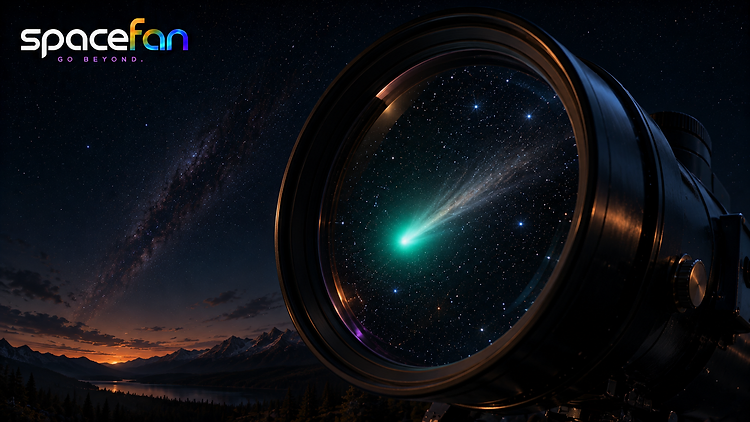
Large telescope lens reflecting a bright green comet beneath the Milky Way above a mountain landscape at dusk.
Image · Space.Fan

The Drop

Space telescopes are incredibly powerful. They collect massive amounts of data from the gas clouds where s are born. For a long time, scientists had to look at this data by hand to figure out which molecules—groups of atoms—were floating in space. This work was very slow and took a long time to finish. Now, a team of researchers has created a new machine learning tool to do the heavy lifting for them. This smart program works in two main steps. First, it looks at the raw data to understand the basic conditions of a gas cloud, such as how fast the gas is moving and how hot it is. Second, it identifies the specific molecules present by checking them against known patterns. By using special computer math, it can even predict what other mystery molecules might be hiding in the data based on what it already found. The team tested this tool on two famous space regions: a dark cloud called TMC-1 and a -forming area named IRAS 16293-2422B. The computer was able to find dozens of different molecules in less than 20 minutes. It was very accurate, identifying more than 90% of the signals in the data during these tests.
Advertisement

Why It Matters

This new tool is a major win for space research because it clears a massive backlog of information. By cutting down the time it takes to analyze space data from months to minutes, it lets scientists move on to the next step of their research much faster. It effectively turns a slow, manual chore into a quick, automated process, allowing researchers to explore the chemistry of the universe at a much larger scale than before.
Advertisement

The Catch

While the tool is very fast, it is not perfect. It still relies on human-checked patterns to make its predictions. If the initial information it is taught contains errors, or if a molecule is completely new and not in the computer's memory, the program might miss it or misidentify it. It is a powerful assistant, but it cannot fully replace the expert knowledge of a human scientist.

Put That in Perspective

In the past, astronomers spent their entire careers analyzing just one or two space maps. As modern telescopes get better and gather even more data, manual analysis would have become impossible. This tool acts as a new pair of eyes, helping researchers keep up with the flood of information coming from the stars.

Source September 26, 2026
Zachary T. P. Fried, Ryan A. Loomis, Jes K. Jørgensen, Andrew Lipnicky, Ci Xue, Gabi Wenzel, Thomas H. Speak, Michael C. McCarthy, and Brett A. McGuire
Massachusetts Institute of Technology, National Radio Astronomy Observatory, University of Copenhagen, Center for Astrophysics | Harvard & Smithsonian, University of British Columbia·The Astrophysical Journal·10.3847/1538-4357/ae9a8e

Keep Exploring Space