Advertisement
Space.Fan — Go Beyond
ApJ · 5 DAYS AGO
UniversePEER REVIEWED

New Clues About Strange Radio Bursts in Old Galaxies

By Space.Fan Editorial Desk

Scientists discovered that mysterious, repeating radio signals can come from very old, quiet galaxies, not just young, active ones.
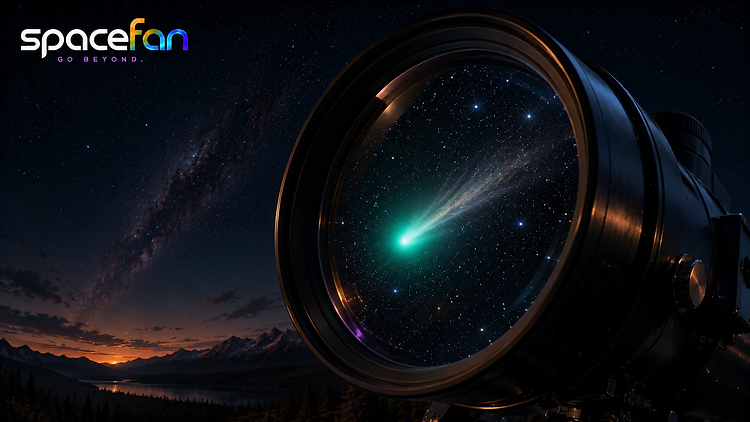
Large telescope lens reflecting a bright green comet beneath the Milky Way above a mountain landscape at dusk.
Image · Space.Fan

The Drop

Fast radio bursts are incredibly powerful, short-lived flashes of radio waves that zoom across the universe. For a long time, experts mostly saw these flashes coming from areas where s were still being born. This discovery focuses on a repeating source called FRB 20240209A, which is located in a very old, quiet elliptical galaxy. This galaxy is about 11 billion years old, making it a surprising home for such energetic events. By using the massive Green Bank Telescope, astronomers watched this source closely and captured three distinct radio flashes. One of these flashes was particularly detailed, breaking into eight separate parts that dropped in frequency over time. By looking at the light patterns of these signals, specifically their polarization, the team was able to study the environment surrounding the source. They found that the area around this burst is complex and filled with magnetic energy, despite the galaxy being old and inactive. This suggests that the environment near a burst might be just as important as the type of galaxy it calls home.
Advertisement

Why It Matters

This finding is important because it shows that the way these radio bursts are born might be more diverse than we once thought. Scientists previously assumed these bursts needed the extreme conditions found in young, -forming galaxies to occur. Now, knowing they can happen in old, quiet galaxies tells us that there are likely multiple ways these bursts can be created in the cosmos.
Advertisement

The Catch

While this study provides new evidence, it is based on observing only a few bursts from one specific source. It is still hard to say for sure if all bursts in older galaxies happen exactly the same way. More observations of different sources are needed to see if these patterns hold up across the entire universe.

Put That in Perspective

Researchers compare the magnetic environment of this old galaxy to the messy surroundings of younger galaxies where other repeaters have been found. Future studies will likely look at more sources in quiet, older galaxies to test if these environments share the same hidden magnetic features.

Source November 18, 2026
Yong-Kun Zhang, Yi Feng, Di Li, Jin-Tao Xie, Chao-Wei Tsai, Pei Wang, Meng-Yao Xue
National Astronomical Observatories, Chinese Academy of Sciences, Zhejiang Laboratory, Zhejiang University, Tsinghua University, Sichuan University of Science and Engineering, Beijing Normal University, University of Chinese Academy of Sciences·The Astrophysical Journal·10.3847/1538-4357/aeb940

Keep Exploring Space