Advertisement
Space.Fan — Go Beyond
ApJ · 2 DAYS AGO
UniverseSIMULATION

New Computer Models Reveal Secrets of Glowing Galaxy Bars

By Space.Fan Editorial Desk

Scientists have created a better way to map how gas moves inside spiral galaxies like our own Milky Way.
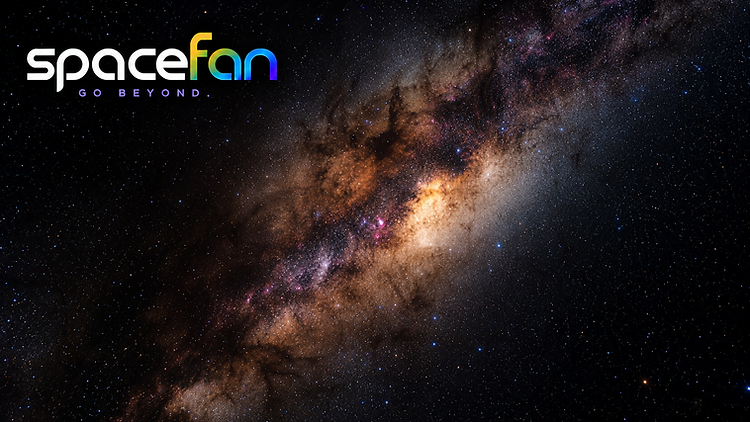
Dense star fields and glowing dust clouds across the center of the Milky Way galaxy.
Image · Space.Fan

The Drop

Many spiral galaxies have a bright bar of s stretching across their centers. For a long time, it has been hard to track exactly how gas flows within these busy regions. To figure this out, researchers used powerful computer simulations to mimic the life of a galaxy. By running these experiments, they could see how gas and s act together over millions of years. The team found that having a lot of gas changes how a galaxy bar grows. In very gas-rich galaxies, the gas actually stops the bar from forming or slows it down significantly. As the bar begins to spin, the gas moves along complicated paths, often getting squeezed and shocked as it travels through the galaxy's center. To keep track of this movement, the researchers built a new tool called the Barflow model. This model acts like a math translator. It helps astronomers look at blurry data from telescopes and more clearly understand how the gas is really moving. It works much better than older methods that assumed gas followed simple, perfect circles.
Advertisement

Why It Matters

This study is important because it changes how we interpret data from telescopes. By using the Barflow model, scientists can now separate the movements of s from the movements of gas more accurately. This gives us a much clearer picture of how galaxies evolve, how they create new s, and how they pull gas into their centers to feed massive s.
Advertisement

The Catch

This study relies entirely on computer simulations rather than direct observations of distant galaxies. While these models are designed to represent realistic, Milky Way-like galaxies, they cannot capture every single detail of the real universe. The results depend on the assumptions made at the t, such as how much gas the galaxy ted with and how its s interact.

Put That in Perspective

Astronomers have known for years that stars and gas move in complex ways, but they previously lacked a simple way to describe these jagged, non-circular flows. This new model provides a standard language for future research, which will likely be tested against high-resolution images from modern space telescopes to see if the predictions match what we see in the sky.

Source November 20, 2026
Seungwon Baek, Woong-Tae Kim, Taehyun Kim, Dajeong Jang, SungWon Kwak
Seoul National University, Yonsei University, Korea Astronomy and Space Science Institute, Leibniz-Institut für Astrophysik Potsdam·The Astrophysical Journal·10.3847/1538-4357/aeb4a1

Keep Exploring Space