Advertisement
Space.Fan — Go Beyond
ApJ · 5 DAYS AGO
Sun & Space WeatherPEER REVIEWED

Parker Solar Probe Spots Hammerhead Patterns in Solar Wind

By Space.Fan Editorial Desk

Scientists have found strange, hammerhead-shaped energy patterns in the sun's solar wind that help explain how it stays so hot.
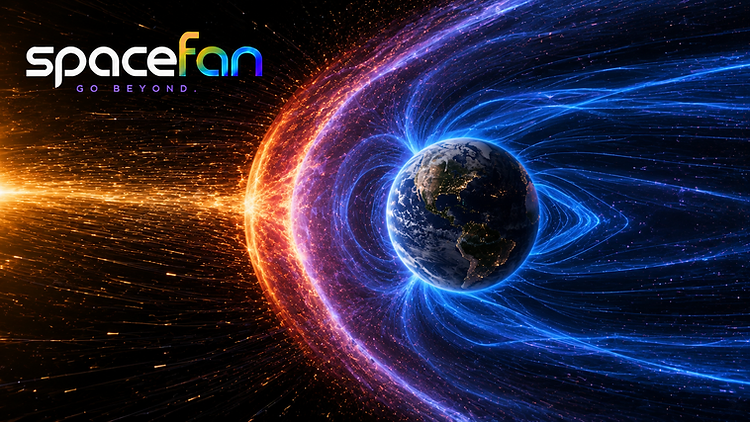
Earth surrounded by glowing magnetic field lines as solar particles strike the magnetosphere.
Image · Space.Fan

The Drop

The sun is constantly blowing a stream of charged particles into space, known as the solar wind. One of the biggest mysteries in space science is why this wind stays so hot even as it travels far away from the sun's surface. Recently, NASA's Parker Solar Probe discovered a unique pattern in the speed and movement of these particles. Because of their shape on a data graph, researchers are calling these patterns hammerheads. These shapes appear most often near the heliospheric current sheet, which is a giant, wavy layer that cuts through the solar system like a skirt attached to the sun. Scientists studied these patterns using complex computer simulations that mimic how particles and waves interact in space. By comparing these simulations to the actual data gathered by the spacecraft, the team confirmed that these hammerhead shapes act like a fingerprint for how the solar wind gets its energy. It appears that specific plasma waves are giving these particles an extra boost of heat. This discovery provides a new piece of the puzzle in figuring out how the sun heats up the space around it.
Advertisement

Why It Matters

Understanding how the solar wind is heated is vital for predicting space weather. When this hot, fast-moving wind hits Earth, it can affect our satellites, GPS signals, and power grids. By identifying exactly how these hammerhead patterns transfer energy to particles, scientists can create better models to predict how the solar wind will behave before it reaches our .
Advertisement

The Catch

While these simulations match what the probe saw, they were done under idealized conditions. Real space is much messier and more chaotic than a computer simulation can perfectly capture. Researchers still need more data to see if these patterns look the same in all parts of the sun's atmosphere or if they change over longer periods of time.

Put That in Perspective

Scientists have been studying the solar wind for decades, but the Parker Solar Probe is the first mission to fly close enough to the sun to see these tiny, fast-moving kinetic events. Researchers plan to use these findings to guide future observations and see if similar patterns exist in other parts of the sun's environment.

Source November 17, 2026
L. Pezzini, J. L. Verniero, F. Bacchini, A. N. Zhukov, G. Arrò, R. A. López
KU Leuven, Royal Observatory of Belgium, NASA Goddard Space Flight Center, Royal Belgian Institute for Space Aeronomy, Moscow State University, University of Wisconsin-Madison, Comisión Chilena de Energía Nuclear, Universidad Andres Bello·The Astrophysical Journal·10.3847/1538-4357/aeab85

Keep Exploring Space