Space.Fan — Go Beyond
ApJL · 23 HR AGO
Sun & Space WeatherPEER REVIEWED

Scientists Detect Rare Gamma-Ray Burst from the Sun

By Space.Fan Editorial Desk

For the first time, researchers have captured a major solar event using gamma-ray detectors at both the North and South Poles.
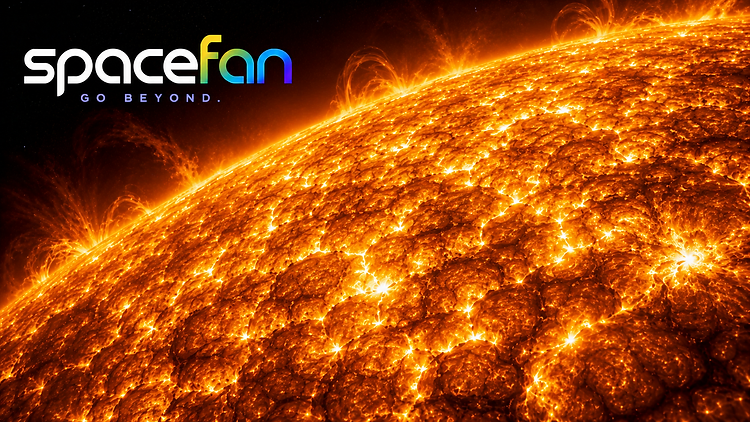
Close-up of the fiery Sun showing bright active regions and looping plasma above its surface.
Image · Space.Fan

The Drop

On November 11, 2025, our sun released a massive blast of energy. This event included a powerful solar flare and a fast cloud of particles known as a coronal mass ejection. These events created a rare phenomenon called a ground-level enhancement. This happens when high-energy particles from the sun slam into Earth's atmosphere, creating a cascade of secondary radiation that can reach the ground. Scientists detected this radiation using special gamma-ray sensors located in Antarctica and the Arctic. This was the first time these sensors were used to record such an event. The detectors at both ends of the caught the data, but they did not see the exact same thing. The researchers noticed two different patterns in the gamma rays. In Antarctica, the radiation appeared quickly and was very strong. In the Arctic, the signal was more gradual and much weaker. By comparing these differences, the team gained a better understanding of how solar particles travel through space and interact with Earth's magnetic shield.

Why It Matters

This discovery proves that gamma-ray detectors at the poles are vital tools for space weather monitoring. Previously, scientists mostly relied on neutron monitors to track these high-energy solar events. Now, they have a new, complementary way to measure the power of solar storms as they hit our . This helps improve our ability to track dangerous solar activity that could affect satellites and power grids on Earth.

Aurora Tonight

Live NOAA outlook

Low aurora activity

Mostly Arctic: Alaska, northern Canada, Greenland, and far-northern Europe

Aurora activity19%
Peak Kp tonight: 2NOAA nowcast max: 13%Source: NOAA SWPC

Aurora forecasts are probabilistic. Darkness, clouds, local light pollution, and rapidly changing solar-wind conditions affect what you can actually see.

The Catch

While the data confirms the event took place, the researchers noted that the sensors in Antarctica and the Arctic gave very different results. The amplitude of the radiation was ten times stronger in the South than in the North. This difference highlights that local conditions at the poles or the path the particles took through Earth's magnetic field significantly changed how the event was measured at each site.

Put That in Perspective

Scientists have tracked solar storms for many years using traditional methods, but this observation marks a major step forward in detection technology. By using polar gamma-ray stations, researchers hope to fill in gaps in our knowledge of how solar particles reach the surface, especially during the most extreme space weather events.

Source November 21, 2026
Pranali Thakur, Geeta Vichare, Nat Gopalswamy, Selvaraj Chelliah
Indian Institute of Geomagnetism, NASA Goddard Space Flight Center, The Catholic University of America, Equatorial Geophysical Research Laboratory·The Astrophysical Journal Letters·10.3847/2041-8213/aeaee7

Keep Exploring Space