Advertisement
Space.Fan — Go Beyond
ApJL · 2 DAYS AGO
UniverseMODEL

Scientists Find a New Way to Spot Hidden Black Holes Near the Milky Way Center

By Space.Fan Editorial Desk

Researchers have discovered a clever trick to detect massive, unseen objects lurking near the giant black hole at the heart of our galaxy.
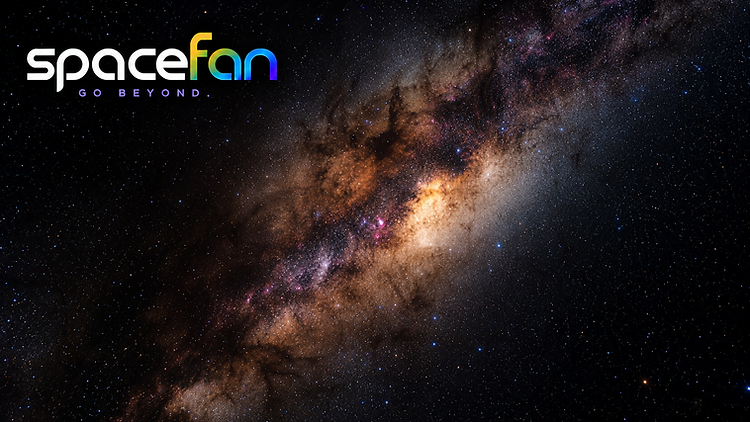
Dense star fields and glowing dust clouds across the center of the Milky Way galaxy.
Image · Space.Fan

The Drop

At the very center of our galaxy, there is a supermassive . Around it, other smaller but still very heavy s are slowly spiraling inward. These moving objects are hard to see directly, but they tug on the s around them as they pass by. Scientists have now found a way to use the movement of a specific , called S301, to track these hidden travelers. By watching how this moves over many years, astronomers can spot the tiny, specific wobbles caused by these heavy, invisible neighbors. Usually, it is very hard to tell the difference between the tug of these s and the general chaos of other s in the area. To solve this, researchers used a math method called a wavelet transform. Think of this like a special filter that ignores the background noise of normal movement to highlight the clear, sharp signals left behind by the passing s. This method allows scientists to identify the gravitational pull of these objects even when the movement is too small for our current telescopes to measure directly. Based on their math models, the team believes they can confirm the presence of at least two of these unseen objects within just five to nine years of careful tracking.
Advertisement

Why It Matters

This discovery is important because it gives us a way to 'see' the invisible population of s that are constantly moving toward the center of our galaxy. By counting how many of these objects exist, scientists can better understand how our galaxy evolves and how s grow over long periods of time. Previously, we had to wait for future space-based detectors to find these objects. This new method allows astronomers to search for them right now using the telescopes and data we already have, speeding up our understanding of the mysterious Galactic Center.
Advertisement

The Catch

This method relies on a mathematical model that assumes we can perfectly separate the signal of a from the random jiggling of other s nearby. If our current measurements of the S301 have small errors, or if the environment near the is more crowded and chaotic than expected, the results could be harder to read than the model predicts.

Put That in Perspective

Astronomers have tracked stars at the galactic center for decades to prove the existence of our central black hole. This new study is a major step forward because it shifts the focus from just watching the biggest objects to finding the smaller, hidden ones that are usually too faint to detect until they get very close.

Source November 21, 2026
Pau Amaro Seoane, Qimin Song, Shao-Dong Zhao, Kostas Tzanavaris, Reinhard Genzel, Frank Eisenhauer, Thomas Ott, Stefan Gillessen, Guillaume Bourdarot, Diogo C. Ribeiro
Universitat Politècnica de València, Max Planck Institute for Extraterrestrial Physics, Peking University, Lanzhou University, Max Planck Institute for Gravitational Physics, University of California Berkeley, Technical University of Munich·The Astrophysical Journal Letters·10.3847/2041-8213/aeb888

Keep Exploring Space