Advertisement
Space.Fan — Go Beyond
ApJ · 4 DAYS AGO
Sun & Space WeatherNEW OBSERVATION

Scientists See Solar Wind Waves Bouncing Back Near the Sun

By Space.Fan Editorial Desk

New radio signals from the Tianwen-1 spacecraft confirm that solar energy waves reflect as they travel away from the Sun.
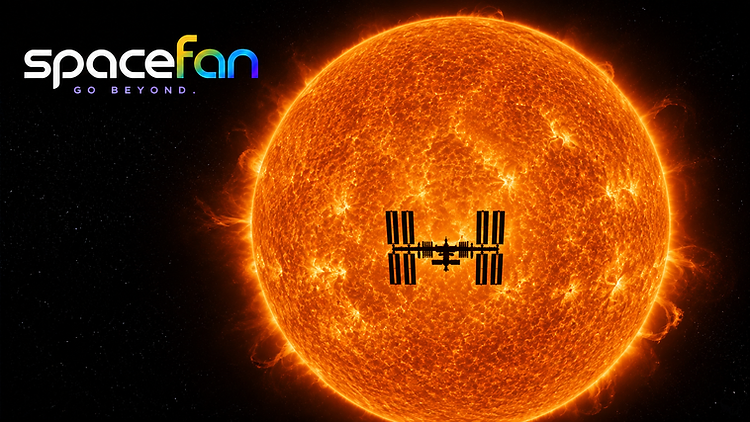
Silhouette of the International Space Station crossing in front of the bright orange Sun.
Image · Space.Fan

The Drop

The Sun constantly blows a stream of particles into space called the solar wind. For a long time, scientists suspected that some of the energy in this wind reflects off of patches of denser gas and heads back toward the Sun, but they had never seen it happen. Now, by using radio signals from China's Tianwen-1 spacecraft, researchers have finally caught this event in action. To see these waves, the team used a method called radio sounding. They sent signals through the solar wind and watched how the waves behaved. They found that while most of the wind moves outward, there are specific disturbances moving backward at the same time. These inward-moving waves are the missing piece of the puzzle that experts have been looking for. By comparing these real-life observations to computer models, the team confirmed that these waves are bouncing off of thicker areas of solar gas. This proves that the environment near the Sun is much more active and complex than simple one-way streams. It is similar to watching ripples in a pond hit a rock and splash back the other way.
Advertisement

Why It Matters

This discovery is important because it changes how we understand the speed of the solar wind. Scientists have long debated why the wind speeds up so quickly as it leaves the Sun. Knowing that waves reflect and interact with turbulence gives researchers the missing data needed to solve this mystery. It confirms that the energy powering the solar wind is constantly being recycled and redirected.
Advertisement

The Catch

While these observations provide strong evidence for wave reflection, the study focused on specific distances from the Sun. It is still difficult to know if this process happens the same way everywhere in the solar atmosphere. Scientists rely on complex computer simulations to verify their findings, which means there could still be other unknown factors influencing the movement of these waves.

Put That in Perspective

This is the first time researchers have been able to use remote-sensing tools to see this reflection in the region where the solar wind is born. In the past, scientists could only guess at this process based on math theories. Future missions will likely use this method to look at other parts of the Sun to see if this bouncing wave behavior is a standard rule of space weather.

Source November 18, 2026
ApJ

Keep Exploring Space