Space.Fan — Go Beyond
ApJ · 2 DAYS AGO
Sun & Space WeatherMODEL

Solving a Solar Mystery: How Sun Waves Reveal Hidden Secrets

By Space.Fan Editorial Desk

Scientists have discovered that waves in the Sun's atmosphere behave differently than we thought, changing how we measure its hidden speed.
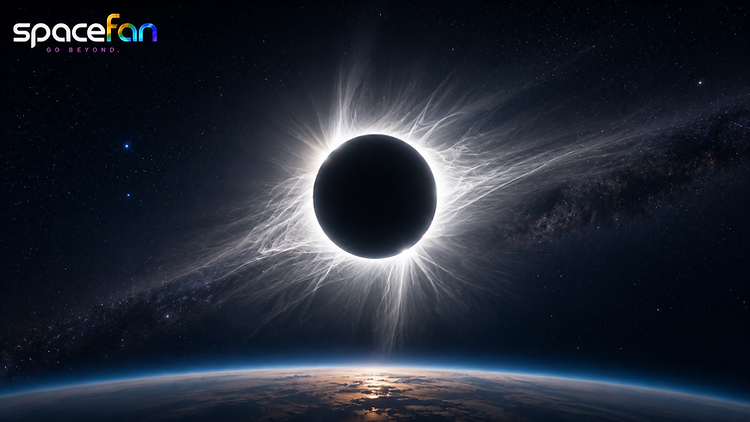
Total solar eclipse with a brilliant white corona suspended above the curved horizon of Earth viewed from space.
Image · Space.Fan

The Drop

When giant clouds of solar material, known as coronal mass ejections, crash into the Sun's atmosphere, they send ripples through the area like a pebble hitting a pond. These ripples are called kink waves. For a long time, scientists have used these waves to measure how fast magnetic signals move through the Sun's outer layer, which helps us understand the 's magnetic energy. Researchers previously assumed these waves traveled in a straight line outward, similar to a beam of light shooting directly away from the center. However, new computer models show that these waves often travel at an angle, or 'obliquely,' rather than in a perfectly straight line. This happens because the giant solar explosions do not always hit the Sun's magnetic field straight on. By studying how these angled waves move, researchers discovered that our previous math calculations were slightly off. When the waves are tilted, they look like they are moving slower than they actually are, leading to incorrect speed readings.

Why It Matters

This discovery acts like a better ruler for solar scientists. Because we were missing the 'tilt' of these waves, our past speed estimates for the solar corona were often too low. By accounting for the angle of these waves, experts can now get a much more accurate picture of the magnetic environment near the Sun. This improves our ability to study the solar wind and how energy travels through space, which is important for protecting satellites and technology on Earth.

Aurora Tonight

Live NOAA outlook

Low aurora activity

Mostly Arctic: Alaska, northern Canada, Greenland, and far-northern Europe

Aurora activity20%
Peak Kp tonight: 2NOAA nowcast max: 14%Source: NOAA SWPC

Aurora forecasts are probabilistic. Darkness, clouds, local light pollution, and rapidly changing solar-wind conditions affect what you can actually see.

The Catch

This study is based on mathematical models and theories rather than direct, close-up physical measurements of the waves. Because these waves are happening millions of miles away in the solar atmosphere, we cannot simply touch them or track them with a sensor. The research team notes that to be truly certain, we need to view these waves from two different locations at the same time—a method called stereoscopic observation—to see the true angle of their path.

Put That in Perspective

In the past, astronomers could only guess the speed of these magnetic waves based on simple, flat-plane assumptions. This new work highlights that the solar corona is a complex, three-dimensional environment. Moving forward, scientists will likely use data from multiple space telescopes working together to confirm these findings.

Source November 20, 2026
Aleksandr V. Rubtsov, Valery M. Nakariakov, Dmitri Yu. Klimushkin, Ding Yuan
Harbin Institute of Technology, University of Warwick, Kyung Hee University, Universidad Bernardo O’Higgins, Institute of Solar-Terrestrial Physics SB RAS·The Astrophysical Journal·10.3847/1538-4357/aeaa41

Keep Exploring Space