
Advertisement
Space.Fan — Go Beyond
ApJ · 2 DAYS AGO
UniverseMODEL

Solving the Mystery of a Strange Pulsar Spinning in Deep Space

By Space.Fan Editorial Desk

Scientists have uncovered why a rare, super-fast star is behaving in such a strange and unexpected way.
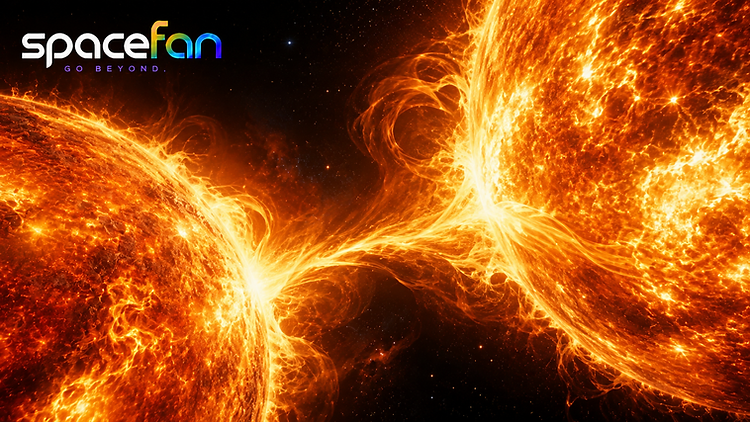
Two fiery stars interacting through huge glowing loops and streams of stellar plasma.
Image · Space.Fan

The Drop

Deep in space, there is a special type of called a pulsar. Pulsars are dead s that spin incredibly fast, like a cosmic spinning top. Usually, these s slow down as they age. However, one pulsar named J0435 is acting very oddly. It is spinning down much faster than any other similar we have ever seen, happening nearly 100 times quicker than expected. This makes it a real puzzle for experts who study how s live and die. To understand why this is happening, scientists built computer models to recreate the life cycle of this . They looked at how it lived with another nearby in a partnership called a binary system. By studying the way the pulsar interacts with its partner, they found a missing piece of the puzzle. They believe that intense X-rays from the hit the companion , which then changes how the system evolves over time. When scientists added this 'irradiation effect' to their computer simulations, the model matched the real-life observations of J0435 perfectly. This explains how the pulsar could end up with its fast spin-down rate while still looking the way it does today.
Advertisement

Why It Matters

This discovery is a big deal because it helps us test our theories about how s grow and change over billions of years. By proving that X-rays can change a 's path, researchers can better understand the complicated history of binary systems. It gives them a new tool to solve mysteries about other strange pulsars that do not seem to fit the normal rules of the universe.
Advertisement

The Catch

While the computer models match what we see in the sky, they are still just simulations. They show one possible path for how the pulsar formed, but they cannot prove that this is exactly what happened in history. We have not seen the process happen in real-time, so there could still be other reasons for the pulsar's unusual behavior that scientists have not discovered yet.

Put That in Perspective

Pulsars are some of the most extreme objects in the universe. While a normal star like our Sun is huge and slow, these objects are packed into a ball the size of a city but contain more mass than the Sun. Scientists hope to use this model to study other 'peculiar' pulsars to see if they follow the same rules, helping us build a better map of how these cosmic spinning tops behave across the galaxy.

Source November 21, 2026
Kai-Liang Guan, Zhi-Fu Gao, Long Jiang, Wen-Cong Chen
Qingdao University of Technology, Xinjiang Astronomical Observatory, Shangqiu Normal University·The Astrophysical Journal·10.3847/1538-4357/aeb54b

Keep Exploring Space



