Advertisement
Space.Fan — Go Beyond
Universe Today · 8 HR AGO
UniversePEER REVIEWED

Solving the Mystery of Strontium in Ancient Stars

By Space.Fan Editorial Desk

A clever lab experiment finally explains why old stars have more of a common glow-in-the-dark element than scientists expected.
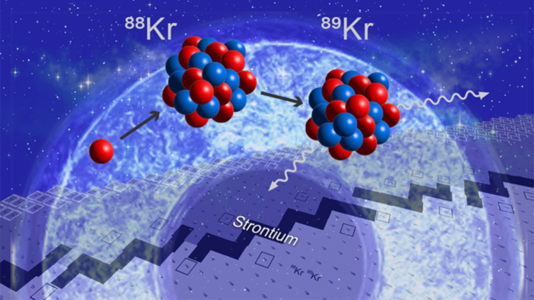
A scientific visualization showing the nuclear reactions that create strontium inside of a star.
Image · Universe Today

The Drop

Everything in our universe, from the gold in your phone to the calcium in your bones, was born inside a . For a long time, scientists have been puzzled by how much strontium—the element used in red fireworks and glow-in-the-dark paint—appears in the oldest s. Scientists expected to see less of it based on their computer models of how s work. This mismatch suggested that our understanding of how s cook up new elements was incomplete. To solve this, researchers needed to measure how a specific, short-lived version of the element Krypton acts when it encounters neutrons. Measuring this is difficult because this type of Krypton disappears in just a few hours. The team used a powerful facility at the Argonne National Laboratory to study a related element called Bromine-89. By looking at how Bromine-89 breaks down, they were able to calculate the missing values they needed for Krypton. They used a special device called a SuN detector to watch gamma rays, which allowed them to pull out the exact data required to update their math models. The results show that their new understanding of these nuclear reactions aligns much better with what they actually see in space.
Advertisement

Why It Matters

This discovery helps scientists fix the "recipe book" they use to explain how elements formed in the early universe. By getting the physics right for Krypton, researchers can now accurately predict the amount of strontium found in ancient s. This confirms that a process called the intermediate neutron-capture process is a real and important way that s create elements, filling a gap between the two previously known methods.
Advertisement

The Catch

While this experiment provides a much better answer, it is still a model-based result. The researchers studied a different element to learn about the one they couldn't directly measure. Future observations of even older s will be needed to see if this new math holds true across every type of observed in the deep sky.

Put That in Perspective

Scientists have spent decades trying to figure out how stars create heavier elements. This study shows that even tiny, invisible particles like neutrons can change our entire understanding of how a star functions over billions of years.

Source September 28, 2026
Caley M. Harris
Michigan State University, Argonne National Laboratory·Nature Communications Physics

Keep Exploring Space