Advertisement
Space.Fan — Go Beyond
ApJS · 7 DAYS AGO
UniverseMODEL

Supercomputer Models Reveal How Massive Stars Die in Violent Explosions

By Space.Fan Editorial Desk

Scientists created a new library of digital stars to help us understand how some of the most powerful explosions in the universe occur.
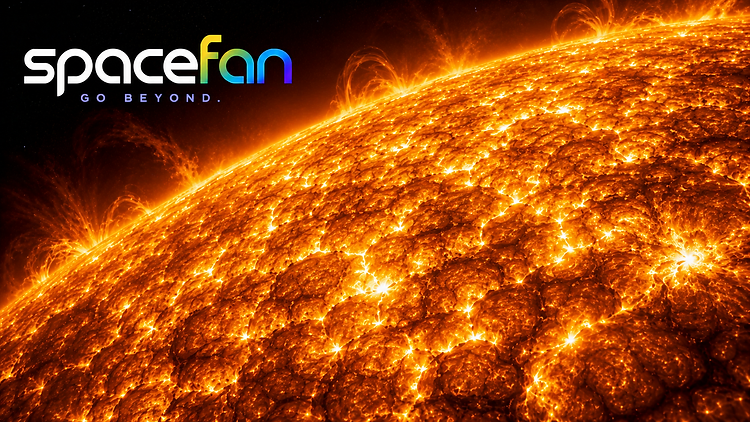
Close-up of the fiery Sun showing bright active regions and looping plasma above its surface.
Image · Space.Fan

The Drop

When a much larger than our sun runs out of fuel, it can die in a spectacular explosion. Some of these are known as e or gamma-ray bursts. Scientists have a hard time predicting exactly how these s look and act right before they collapse, which makes it difficult to understand why they explode the way they do. To solve this, researchers used a powerful computer program called MESA to build 113 different digital models of massive s. These s were set up to be very heavy and spin incredibly fast. The team focused on s that were between 30 and 90 times the mass of our sun. By simulating how these s evolve over time, the researchers were able to track how their insides change as they get closer to the end of their lives. Instead of looking at s through a telescope, the team used math to simulate the 's life cycle. They included detailed calculations for 128 different types of particles within the s. This allowed them to see how the 's core behaves as it creates energy and moves toward a final, massive collapse. The result is a detailed map that helps astronomers recognize the signs of a ready to explode in a jet of energy.
Advertisement

Why It Matters

This set of models is important because it gives scientists a consistent 'cheat sheet' to compare against real explosions seen in the sky. Before this, researchers had limited models to work with, which made it hard to match observations to theory. Now, astronomers can look at a distant, massive explosion and check it against these new simulations to see if their findings match up with what we know about rapidly spinning, massive s.
Advertisement

The Catch

These findings are based entirely on computer simulations. While these models use the best physics we currently know, they are still just math-based guesses about how real s behave. It is possible that real-world s have hidden factors or magnetic forces that these models do not account for yet, meaning the simulations might not perfectly represent every in the universe.

Put That in Perspective

Scientists have been studying how stars end their lives for decades, but modern computers now allow for much more detail than before. This work follows a long line of research into stellar evolution. Next, the team will likely test these models against observations of real gamma-ray bursts to see if the predictions hold true in the wild.

Source November 15, 2026
ApJS

Keep Exploring Space