Advertisement
Space.Fan — Go Beyond
ApJL · 2 DAYS AGO
UniversePEER REVIEWED

Webb Telescope Finds a Tiny Galaxy That Could Rewrite History

By Space.Fan Editorial Desk

Astronomers spotted a tiny, extremely bright galaxy that helps explain how the early universe first filled with light.
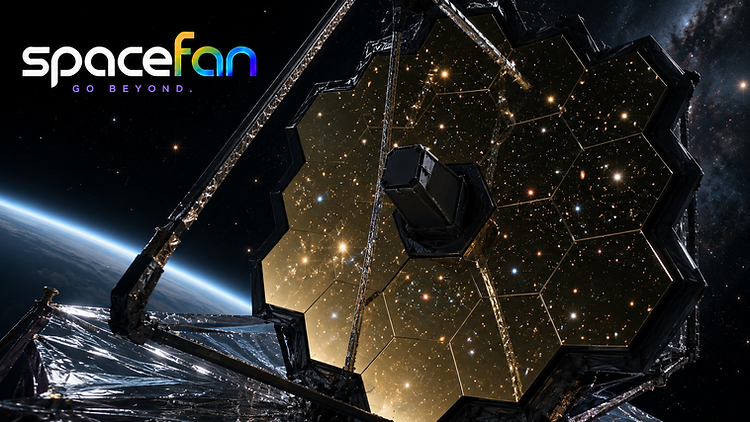
James Webb Space Telescope in space with its gold segmented mirror facing the stars.
Image · Space.Fan

The Drop

Scientists using the James Webb Space Telescope have discovered one of the smallest and faintest galaxies ever seen from the early universe. They nicknamed this object SALSA. It existed when the universe was less than a billion years old. Because it is so far away, it is normally invisible to our telescopes, but it was caught hiding behind a massive galaxy cluster. This cluster acted like a natural magnifying glass in space, bending the light of the tiny galaxy so we could see it clearly. Researchers used a special instrument on the Webb telescope called the Near-Infrared Spectrograph to break down the light coming from SALSA. By studying this light, the team measured the chemical makeup and temperature of the galaxy. They found that SALSA is packed with very hot, young s that shine with incredible intensity. This galaxy acts as a lighthouse in the dark, early universe, showing us what the very first generation of -forming regions looked like.
Advertisement

Why It Matters

This discovery helps solve a big puzzle about the Epoch of Reionization, a time when the first s and galaxies burned through the cosmic fog to make the universe transparent. Scientists needed to know what kind of objects provided the energy to clear this fog. By studying SALSA, researchers now have proof that tiny, faint galaxies were likely responsible for pumping out massive amounts of radiation, which helped shape the universe as we see it today.
Advertisement

The Catch

While the galaxy is very bright for its size, researchers can only see it because of the extreme magnification from the galaxy cluster in front of it. Because the magnification effect is so complex, there is still some uncertainty in calculating the exact size and age of the galaxy. Scientists also assumed the galaxy has very little dust, which helps them estimate how much light is escaping, but if there is more hidden dust than expected, some of these measurements could shift.

Put That in Perspective

Before the James Webb telescope, we could only see the largest and brightest galaxies from this time period. SALSA is significantly smaller than those giants, suggesting that the early universe was teeming with tiny, energetic galaxies that we are only just beginning to find. Future studies will likely search for more of these small hidden gems to see if they were common everywhere in the early cosmos.

Source November 20, 2026
Sofía Rojas-Ruiz, Matteo Messa, Eros Vanzella, Tommaso Treu, Pietro Bergamini, Giorgia Di Rosa, Marco Lombardi, Piero Rosati, A. Bolamperti, Anita Zanella
University of California, Los Angeles; INAF—OAS·The Astrophysical Journal Letters·10.3847/2041-8213/aebdfe

Keep Exploring Space