Advertisement
Space.Fan — Go Beyond
ApJ · 5 DAYS AGO
UniversePEER REVIEWED

Webb Telescope Refines How We Measure Distances in Deep Space

By Space.Fan Editorial Desk

Scientists used the Webb telescope to get a better look at special blinking stars in a tiny galaxy to improve our cosmic measuring tape.
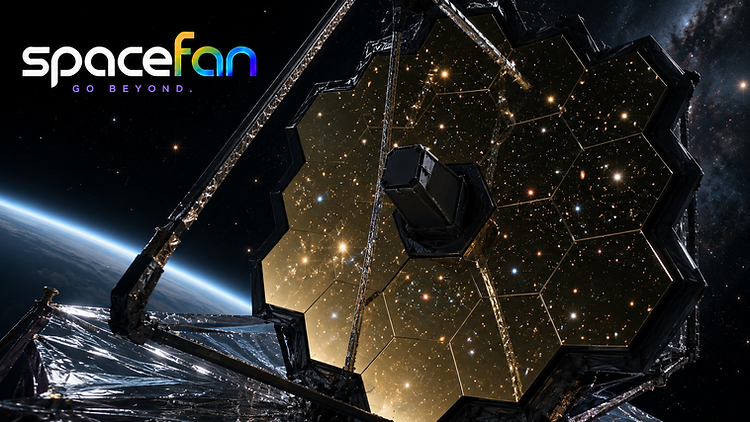
James Webb Space Telescope in space with its gold segmented mirror facing the stars.

The Drop

Astronomers have found a new way to use the James Webb Space Telescope to measure the distance to galaxies. They focused on a group of s called RR Lyrae s located in a small, nearby galaxy known as Leo P. These s are famous because they blink, or change brightness, in a very steady rhythm. By timing these blinks, scientists can figure out exactly how far away these s are from Earth. Because we know how bright these s should be, they act like a standard ruler for space. Previously, scientists used the Hubble Space Telescope to watch these s. By combining the old Hubble data with new, high-quality images from the Webb telescope, the team was able to get a much clearer picture. They identified 20 of these blinking s with Hubble and 15 with Webb, which helped them pin down the distance to Leo P more accurately than before.
Advertisement

Why It Matters

Measuring distances in space is notoriously difficult because we cannot simply travel to distant galaxies with a tape measure. RR Lyrae s are essential because they serve as standard candles, meaning their brightness allows us to calculate how far away they are. By improving the math we use to interpret these s, researchers can create a more reliable map of the universe. This specific study helps refine the formulas scientists use for these calculations, making future distance measurements in the deep universe much more precise.
Advertisement

The Catch

While this study makes our cosmic ruler better, it is limited to a small sample of s in just one dwarf galaxy. Scientists still need to study many more of these s in different types of galaxies to ensure their math holds up everywhere in the universe. There is always a small chance that s in very different environments behave slightly differently, which could lead to tiny errors in measurement.

Put That in Perspective

Before now, astronomers relied heavily on Hubble to see these stars. Webb is much more powerful and can see through space dust and capture more detail, which is why it helps sharpen the results. Future research will likely apply these same techniques to even more distant galaxies to test if the improved math works on a larger scale.

Source November 17, 2026
Catherine M. Slaughter, Alessandro Savino, Meredith Durbin, Andrew E. Dolphin, Kristen B. W. McQuinn, Max J. B. Newman, Evan D. Skillman, Daniel R. Weisz
University of Minnesota, Northwestern University, University of California Berkeley, University of Washington, Raytheon, University of Arizona, Rutgers University, Space Telescope Science Institute·The Astrophysical Journal·10.3847/1538-4357/aeb6b4

Keep Exploring Space