Advertisement
Space.Fan — Go Beyond
ApJ · 8 DAYS AGO
UniverseMODEL

Why Neutron Stars Wobble Like Spinning Tops

By Space.Fan Editorial Desk

Scientists have uncovered why some dead stars spin unevenly, helping us hunt for invisible ripples in space called gravitational waves.
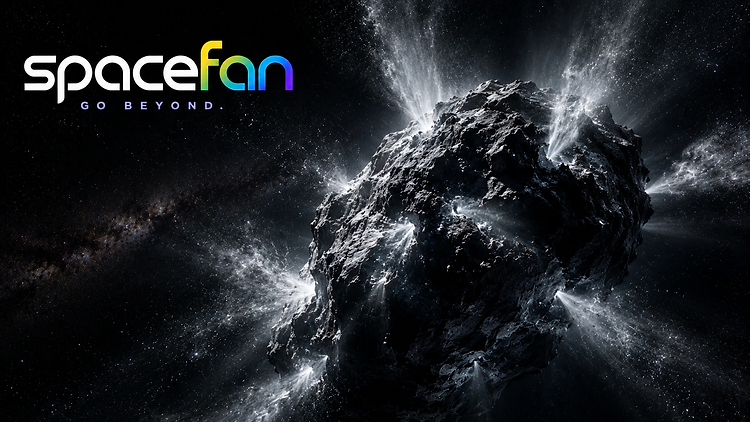
Dark comet nucleus releasing bright jets of gas and dust into surrounding space.
Image · Space.Fan

The Drop

s are the super-dense remains of giant s that have run out of fuel. They spin incredibly fast, sometimes hundreds of times per second. Scientists often look for these s using gravitational waves, which are tiny ripples in the fabric of space. However, these s do not always spin at a perfectly steady pace. Instead, they seem to wander or wobble as they speed up or slow down. Researchers discovered that this wobbling is caused by the messy environment around the . A pulls in gas and dust from nearby s, creating a swirling disk. This process is not smooth. Just like a top that wobbles when it is bumped, the 's spin changes because of random "flicker" noises and instabilities in the falling gas. To figure this out, the team created a mathematical model. They used a concept known as an Ornstein-Uhlenbeck process, which is a way to describe how things change randomly over time. They found that the 's spin changes in a predictable but random pattern based on how much material it is currently eating. Knowing how these s wobble is very important for astronomers. If they know how much a 's speed might change, they can design better computer programs to find the signals coming from them. If the search lasts too long, the signal might get blurry, so knowing when to break the search into smaller, clear pieces is the key to a successful discovery.
Advertisement

Why It Matters

This research changes how we look for gravitational waves from distant s. Because we now understand that these s naturally wander in their spin, scientists can build better tools to track them. It helps turn a messy, unpredictable signal into one that we can actually identify and measure. By narrowing down how much a 's spin can drift, scientists save time. Instead of looking for a perfect, steady signal that doesn't exist, they can now look for segments of data that match the 's actual behavior. This makes it much more likely that we will successfully detect these faint ripples in space.
Advertisement

The Catch

This study is based on a mathematical model and theoretical calculations, not on a direct new observation of a specific . The results depend on assumptions about how gas behaves around a , such as the Rayleigh-Taylor instability. If the real environment around a is different from the model, the predictions about how often researchers need to check their data could change.

Put That in Perspective

Astronomers have long struggled to keep their sensitive detectors focused on fast-spinning objects. Earlier methods often tried to look at long, continuous periods of data, but this new work suggests that shorter "chunks" of data might be the best way to catch the signal before the star's spin drifts too far.

Source November 14, 2026
ApJ

Keep Exploring Space