
Advertisement
Space.Fan — Go Beyond
ApJ · 1 DAY AGO
Solar SystemMODEL

Why Some Planet-Forming Disks Keep Their Shape So Long

By Space.Fan Editorial Desk

Scientists have found that small, wobbly patterns in space dust can get stuck in place for millions of years instead of spreading out.
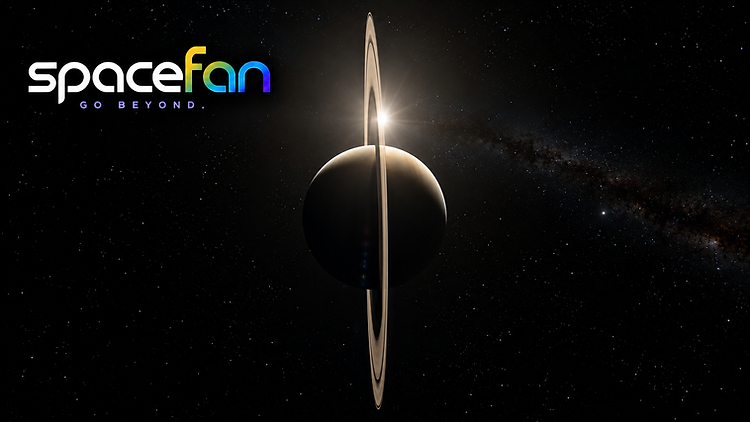
Saturn backlit by the Sun showing its ring system.
Image · Space.Fan

The Drop

When s are born, they are surrounded by a flat, spinning ring of gas and dust called a protoary disk. s form inside these rings. Scientists used to think that any small disturbance, like a slight wobble in the path of the dust, would quickly spread out and disappear across the whole disk. It was expected to act like a ripple in a pond that eventually fades away across the surface. Researchers Konstantin Batygin and Eiichiro Kokubo challenged this old idea. By using computer models to look at how gravity pulls on these dust rings, they discovered something unexpected. They found that if a wobble in the disk is small and narrow enough, it does not spread out at all. Instead, it stays trapped in the same spot for millions of years. This happens because of a special limit called a softening length. Think of it like a speed bump in space. When the wobble is smaller than this bump, its energy cannot move forward easily. It gets stuck, creating a sort of frozen wave that keeps its shape for a very long time. This model helps us understand how s might form in certain areas. Instead of the material in a disk being completely smooth or constantly changing, these stuck wiggles mean some parts of the disk stay different from their neighbors for a long time. This could change how s grow and how they collect their dust and gas.
Advertisement

Why It Matters

This discovery matters because it changes how we model the birth of ary systems. Previously, astronomers assumed that gravity would quickly smooth out any ripples in a disk, leading to a predictable, uniform environment. Knowing that some patterns can get stuck allows scientists to explain why we see strange structures in images of distant, young systems today.
Advertisement

The Catch

This result comes from a mathematical model rather than a direct photo of a space disk. The researchers used a simulation to test their theory of how gravity works over long periods. While the math shows that these wobbles should get stuck, astronomers will need to look for evidence of these trapped patterns in real telescope data to be absolutely sure.

Put That in Perspective

Historically, astronomers viewed disks as simple, smooth systems where material moved in very predictable ways. This new research adds a layer of complexity by showing that the scale of a disturbance really matters. Future research will likely focus on comparing these models with high-resolution images of baby solar systems captured by powerful telescopes.

Source November 21, 2026
Konstantin Batygin and Eiichiro Kokubo
California Institute of Technology and National Astronomical Observatory of Japan·The Astrophysical Journal·10.3847/1538-4357/aeb6b0

Keep Exploring Space



