Advertisement
Space.Fan — Go Beyond
ApJ · 18 HR AGO
UniversePEER REVIEWED

X-Ray 'Mirror' Effect Changes How We Measure Stars

By Space.Fan Editorial Desk

Scientists found that light bouncing off a star's material makes it look much heavier than it actually is.
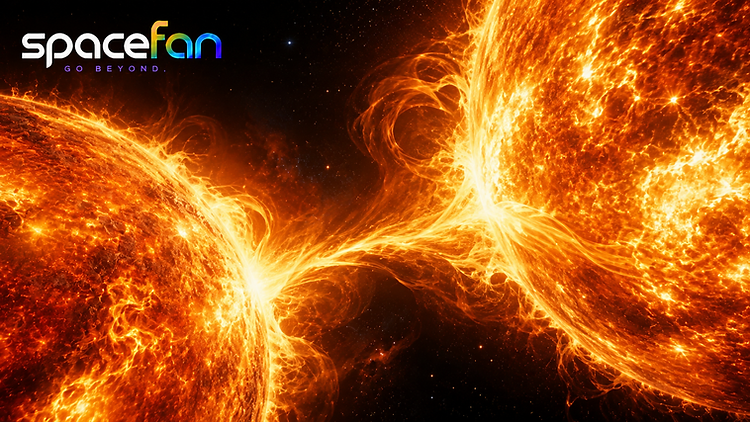
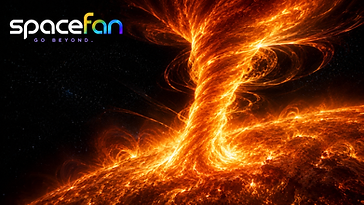
Two fiery stars interacting through huge glowing loops and streams of stellar plasma.
Image · Space.Fan

The Drop

A symbiotic named V648 Car is putting on a strange light show. Scientists have known for a while that this system sends out strong X-rays, but they recently took a closer look using NASA's Nu telescope and the Swift observatory. By combining data from these two powerful space tools, the researchers discovered that a large amount of the X-ray light they see is actually a reflection. Think of it like standing in a room with many mirrors. If you look at the walls, you might think there are more people in the room than there really are because you are seeing reflections of the same person over and over. In the case of V648 Car, gas swirling around the acts like a mirror for X-rays. This 'Compton reflection' accounts for more than one-third of the light being picked up by our telescopes. When astronomers looked at the data without accounting for these reflections, they made mistakes about the 's properties. Because the reflection makes the X-rays look more intense, previous math suggested the was much hotter and heavier than it is. By including the reflection in their new computer models, the team found the is actually about 20 percent lighter than what they had calculated before.
Advertisement

Why It Matters

This discovery matters because it helps astronomers get more accurate measurements of s across the galaxy. If we ignore how light bounces off surrounding space material, we end up with the wrong numbers for mass and temperature. By correctly accounting for this reflection, scientists can now refine how they weigh and measure similar s, leading to a better understanding of how these cosmic systems evolve over time.
Advertisement

The Catch

While the reflection model fits the data much better than previous ones, it is not a perfect picture. The amount of light bouncing around is quite high, which suggests that the setup is more complex than a simple light source shining onto a flat disk. The researchers proposed that multiple layers of reflection might be happening, but they still need to perform more studies to prove exactly how the light is moving through the gas.

Put That in Perspective

In the past, scientists often assumed that the X-rays they saw came directly from the star. Now that they know reflection plays such a huge role in V648 Car, they will likely go back and look at other similar binary star systems to see if they have been miscalculating their weights for years.

Source September 28, 2026
Jhérssica Freitas, Raimundo Lopes de Oliveira, Koji Mukai
Universidade Federal de Sergipe, Observatório Nacional, NASA/GSFC, University of Maryland Baltimore County·The Astrophysical Journal·10.3847/1538-4357/ae939a

Keep Exploring Space